
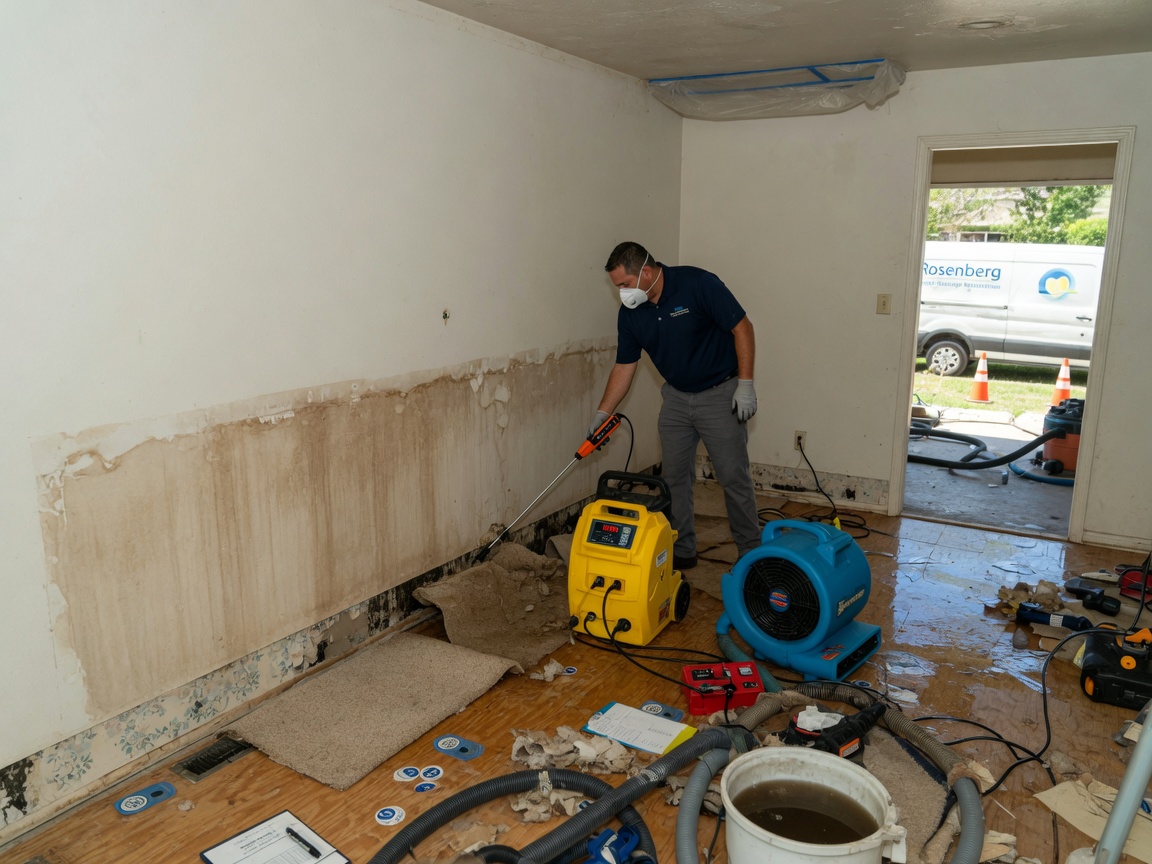
Rosenberg homes in Downtown Rosenberg and Rosenberg Heights often date to the mid-20th century with pier-and-beam foundations and older plumbing that fails during the hot humid summers common in Fort Bend County. When water enters these structures it quickly saturates subfloors and insulation, and the persistent moisture from nearby Brazos River Park and the Brazos River itself keeps humidity high enough to trigger mold within 48 hours. Technicians must pull baseboards, drill weep holes and run commercial dehumidifiers at 30-40 pints per day to pull moisture from the dense clay soils that hold water longer than sandy ground found closer to Sugar Land.
Richmond and Sugar Land residents sometimes see water migrate from the Brazos River during heavy spring rains, but Rosenberg properties face more frequent slab-edge leaks because many neighborhoods sit on flat terrain with poor drainage. Restoration crews use moisture meters on drywall and concrete to map hidden saturation that standard visual checks miss. In mild winters the lack of freezing temperatures means homeowners often delay calling until odors appear, forcing more extensive removal of affected hardwood and carpet padding than would be needed with earlier intervention.
Local code in Fort Bend County requires proper disposal of water-damaged materials and documentation of drying logs when insurance claims are filed. Crews document every step with photos and readings because older Rosenberg Heights homes frequently have knob-and-tube wiring that cannot be exposed to prolonged moisture without creating new hazards. Drying times stretch longer here than in drier West Texas climates because ambient humidity rarely drops below 60 percent even after the rain stops.
Technician insight
In Rosenberg the thing that catches most people out with Water Damage Restoration is how fast the summer humidity turns a small slab leak into mold under the carpet in Rosenberg Heights homes; the clay soil holds moisture so long that drying logs often run seven to ten days even after the rain stops.
Crawl Space Leak Near Brazos River Park
A Rosenberg Heights homeowner noticed musty air after heavy rain. Inspection found water entering through foundation vents from poor drainage near the park. Crews extracted standing water, installed dehumidifiers and removed saturated insulation. The home dried without mold growth and passed final moisture checks.
Water Damage Restoration Services We Offer
✓Emergency Water Extraction
Rapid removal of standing water from slabs, carpets and crawl spaces using truck-mounted pumps to limit secondary damage in humid Fort Bend summers.
✓Structural Drying and Dehumidification
Industrial air movers and dehumidifiers placed throughout affected rooms to pull moisture from walls, subfloors and insulation before mold sets in.
✓Mold Remediation After Water Intrusion
Containment, removal and HEPA filtration of mold colonies that grow quickly in Rosenberg homes after leaks or river-adjacent flooding.
✓Basement and Crawl Space Drying
Targeted drying of pier-and-beam foundations common in Downtown Rosenberg where clay soil retains water and promotes wood rot.
✓Carpet and Hardwood Restoration
Cleaning, drying and reinstallation of flooring materials damaged by leaks, with attention to older homes near the Rosenberg Railroad Museum.
Water Damage Restoration Cost in Rosenberg, TX
| Service | Typical Range | What Affects It |
|---|---|---|
| Emergency Extraction | $300–$900 | Depends on gallons removed and access in older pier-and-beam homes |
| Full Structural Drying | $800–$2,200 | Room count, humidity levels and days of equipment use in humid summers |
| Mold Remediation Add-On | $1,200–$3,500 | Square footage and containment needs after delayed discovery |
| Flooring Removal and Reset | $400–$1,600 | Material type and whether subfloor drying is required |
Ranges are typical for Rosenberg, TX and confirmed with an exact written quote before any work starts.
How it works
- 1
On-Site Assessment
Technician arrives within hours, maps moisture with meters and identifies affected materials in Rosenberg Heights or Downtown Rosenberg homes.
- 2
Water Removal
Pumps and vacuums extract standing water from floors and walls before humidity drives further saturation.
- 3
Drying and Monitoring
Equipment runs until readings confirm dry conditions, with daily checks to adjust for Fort Bend County humidity levels.
- 4
Restoration and Cleanup
Replace removed materials, treat for mold risk and return the property to pre-loss condition.
Pricing
Pricing varies by water volume, affected square footage and how quickly drying begins; most Rosenberg jobs fall between a few hundred and several thousand dollars.