
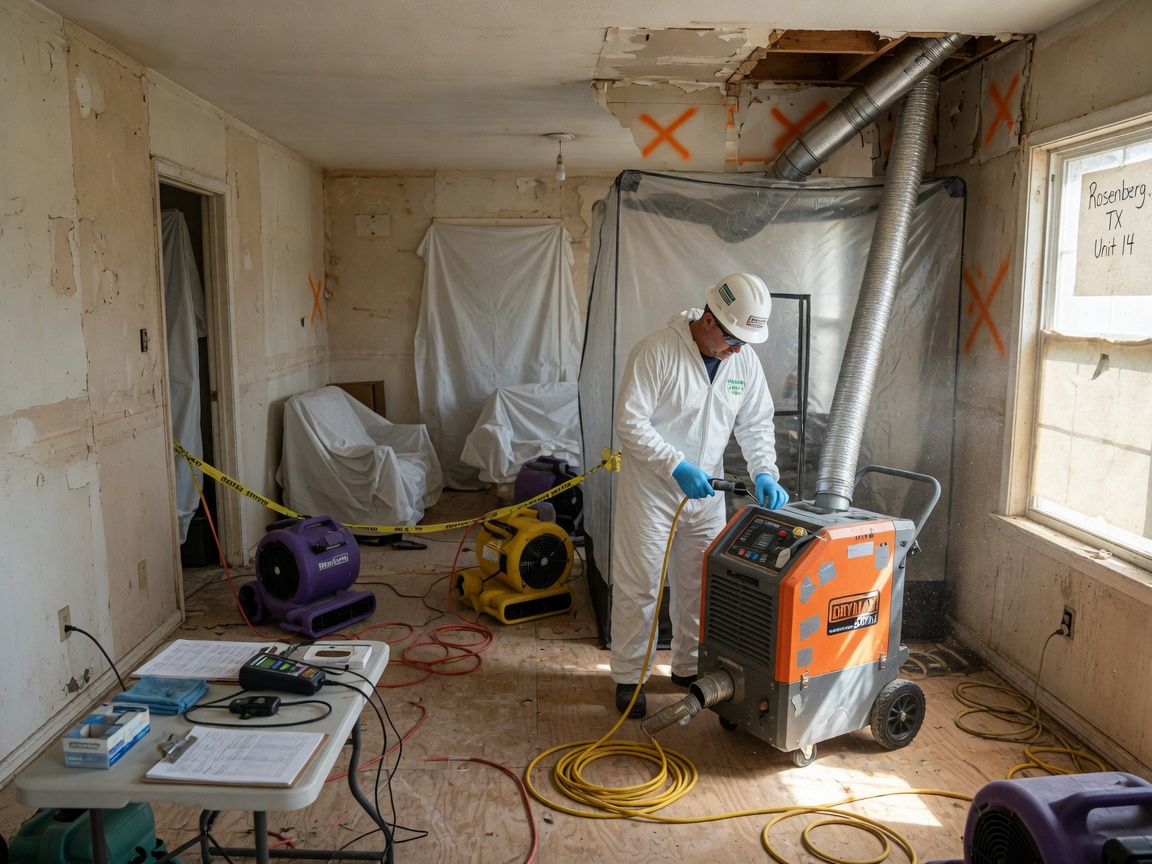
Rosenberg’s hot, humid summers keep indoor moisture levels elevated long after leaks or storms, especially in older wood-frame homes built before 1980 in Downtown Rosenberg and Rosenberg Heights. These properties often have plaster walls and limited crawl-space ventilation that trap water against framing. Without rapid extraction and controlled dehumidification, mold colonies form within 48 hours and spread into Fort Bend County’s clay-heavy soils that already hold moisture near foundations.
We place commercial dehumidifiers and air movers to create negative pressure zones that pull moisture from drywall, subfloors, and insulation while monitoring with moisture meters calibrated for local humidity swings. Homes near the Brazos River Park or close to the railroad tracks frequently see groundwater seepage after heavy rain; we adjust drying plans to account for the mild winters that never fully dry out saturated slabs. Skipping hidden wall cavities or underestimating attic humidity commonly leads to recurring musty odors months later.
Equipment is staged to avoid tripping breakers in older Rosenberg Heights wiring, and we route condensate lines to exterior drains rather than septic systems common in parts of Fort Bend County. Daily readings track progress until moisture content matches pre-loss levels, preventing warped flooring or delaminated cabinets that homeowners in Sugar Land and Richmond report when drying is rushed.
Technician insight
In Rosenberg, the thing that catches most people out with Structural Drying & Dehumidification is underestimating how the hot humid summers keep crawl spaces and wall cavities wet long after the initial water is gone, especially in pre-1980 homes near the Brazos where clay soil never fully dries.
Downtown Rosenberg Home After Pipe Leak
Water from a bathroom supply line migrated under the slab into two bedrooms. We mapped moisture through plaster walls and discovered saturation extending into the crawl space. Equipment ran for five days with daily adjustments for local humidity, returning all materials to dry standards without removing finishes.
Structural Drying & Dehumidification Services We Offer
✓Moisture Mapping in Pre-1980 Homes
Pinpoint hidden saturation in plaster and lathe walls typical of Downtown Rosenberg properties before setting drying zones.
✓Crawl Space Dehumidification
Install sealed dehumidifiers to control ground moisture rising through Fort Bend County clay soils under Rosenberg Heights houses.
✓Slab Edge Drying After River Proximity Flooding
Target perimeter drying where Brazos River Park runoff saturates foundations common near the river corridor.
✓Attic and Insulation Drying
Remove humid air from attics that trap summer moisture in older Rosenberg homes lacking ridge vents.
✓Negative Pressure Containment Setup
Isolate wet zones to stop cross-contamination into unaffected rooms during structural drying jobs.
Structural Drying & Dehumidification Cost in Rosenberg, TX
| Service | Typical Range | What Affects It |
|---|---|---|
| Single-room structural drying | $600–$1,200 | Depends on wall cavity access and daily runtime needed in humid conditions |
| Full-home drying package | $1,800–$3,500 | Covers multiple levels plus crawl space in older Rosenberg Heights homes |
| Crawl space dehumidification add-on | $400–$750 | Sealed system required for Fort Bend clay soil moisture |
| Daily equipment rental extension | $150–$300 per day | Added when summer humidity slows drying progress |
Ranges are typical for Rosenberg, TX and confirmed with an exact written quote before any work starts.
How it works
- 1
Initial Assessment
Walk the property with moisture meters to map saturation in walls, floors, and cavities while noting local soil and humidity conditions.
- 2
Equipment Placement
Position dehumidifiers and air movers to create directed airflow paths that account for Rosenberg’s older home layouts and limited outlets.
- 3
Daily Monitoring
Record moisture readings and adjust equipment until levels stabilize with the area’s typical mild winter baseline.
- 4
Final Verification
Confirm all structural materials return to dry standards before removing equipment and documenting conditions.
Pricing
Pricing varies by square footage affected, number of wet cavities, and how long humidity remains elevated after the initial event.